Info Guru PTK dan Kepegawaian

Minggu, 08 September 2013

Aura


Women all across the country of Sweden are protesting against islamophobia by wearing hijabs. The campaign is to show support with a muslim woman, six months pregnant, who was attacked in a Stockholm suburb for wearing one. Actually racism in Sweden isn't something of the past few years. In fact the number of Islamophobic incidents in Sweden is on the rise. All this came to me as a surprise. I always thought of Sweden as a warm, tolerant country. 
In the country where I live, The Netherlands, there was a similar action in 2010 of non-religious women who set up a headscarf in solidarity. The reason for this was Geert Wilders (a well known Dutch politician, unfortunately), who in pre-election suggested a 'kopvoddentaks' to enter, or a penalty for women who wear headscarves.
I think that the idea of Wilders is ridiculous. In most cases women decide for themselves whether or not they want to wear a headscarf. Most muslim women in the European countries are more independent and western than they were years ago. Also I think it's absurd to punish one on the basis of religion, culture, orgin or color (like most of us, I hope). 


The burqa I find more complicated. It's non-revealing and the woman can't be viewed. Furthermore it is often a sign of women's oppression. (I do not tell that this applies to ALL women who wear a burqa, let that be clear!)
Lady Gaga is playing on dangerous ground with the song Aura of her new, highly anticipated album ARTPOP.  In the song Gaga refers to the burqa as a metaphor for hiding her true self from the public eye. 
I can live with the lyrics I'm not a wandering slave, I'm a woman of choice. But later in the song she lost me when she sings Do you wanna see me naked, lover? Do you wanna peak underneath the cover? In my opinion she suggests that the burqa is a subject of sexual gratification. Also I get the impression that Gaga sees the burqa as some sort of fashion statement instead of a garment with cultural and religious significance. But in the end Gaga is all about controversy. That explains a lot.

Minggu, 01 September 2013

This Must Be The Only Fantasy


This Must Be The Only Fantasy
tells the story about a heroine in the suburbs of Los Angeles. When she goes outside she confronts an evil force. Everything she experiences in channeled through her own reality, it balances between real life and fantasy. During her journey she runs for the dark knight, rides a unicorn and fights with a light saber. In these struggles she gets help of a fairy. The movie is about temptations and dealing with them.
Kate and Laura Mulleavy of Rodarte wanted to tell a story about a hero. 'You live your life in every day but in the other world in your mind you get to live up.' At the end the girl takes the crown. After all everyone's a hero!

The movie responds on things that are very on point. Of course that the digital world is taking over the real world. Todd Cole, the director, says about this topic: 'The idea now that you can make something and that you can distribute it on the internet and that a lot of people will see it online is amazing.'
Magical realism and 1980s video games come together in the stylistic visuals by VFX studio a52. They brought a little magic in the visual effects. Other work of the studio is based on making something for the real, invisible almost. 'With the idea of magical realism we were able to kind of bring more showy effects.' The movie's lead role is played by, quite unknown, 18 year old LA girl and Hedi Slimane muse Sidney Williams. Supermodel Guinevere van Seenus plays a glitchy projection of a fairy.
Also there's an hommage to the king of the world, yes, Elijah Wood a.k.a. Frodo in Lord of the Rings.
All this amazingness is topped of with a soundtrack created by dream pop duo Beach House. 


It's the third movie by the Mulleavy sisters in collaboration with Todd Cole. 'I never think of these films as fashion films', Cole said, 'I think of Kate and Laura's clothes as more of a starting point, and then I create a world for them to exist in.' Rodarte did a collection inspired by medieval role-playing games. The clothes are about playing with different textures, colors and movement. The sisters must have been influenced by their costume designing for opera. It all breathes fantasy, Game of Thrones and a little bit of King Arthur.
'There's an interesting thing about being based in classic ideas of silhouettes, but then playing with them and reinventing them and make people imagine something different.'

Sabtu, 10 Agustus 2013

Black Beauty

Is there too little ethnicity and diversity on the catwalk?
Five years ago there was this discussion. In the meantime, nothing really changed when it comes to casting models.
Quite remarkeble: there were no black models (not even one!) at the shows of Dior and Saint Laurent for fall. In total, for all shows that season there was a ratio of 6% colored models compared to 82.7% white models. The season before it went to 8% of the models. Celine never even casted a model with black skin since Phoebe Philo runs the label.
Raf Simons did cast black models for his latest couture collection. Six to be precise. But isn't that obvious when a show is inspired by global clientele across the continents of Europe, Asia, America and Africa? Given the theme of the collection, it's still the question if next season will be any different.

Selasa, 30 Juli 2013

Kenzomania

Eye see you!

In art nouveau department store La Samaritaine, that hasn't been used for decades, Carol Lim and Humberto Leon of Kenzo showed their fall collection. Inspired by trips to India, exoticness was everywhere. The layering was based on  the way Indian temples are built. The oriental influences are also visibal through the colors. Gold, red and royal blue dominated. The duo chose an third eye motif that popped up on shirts, sweaters and trousers. 'It's all about protection and warding off evil spirits.'


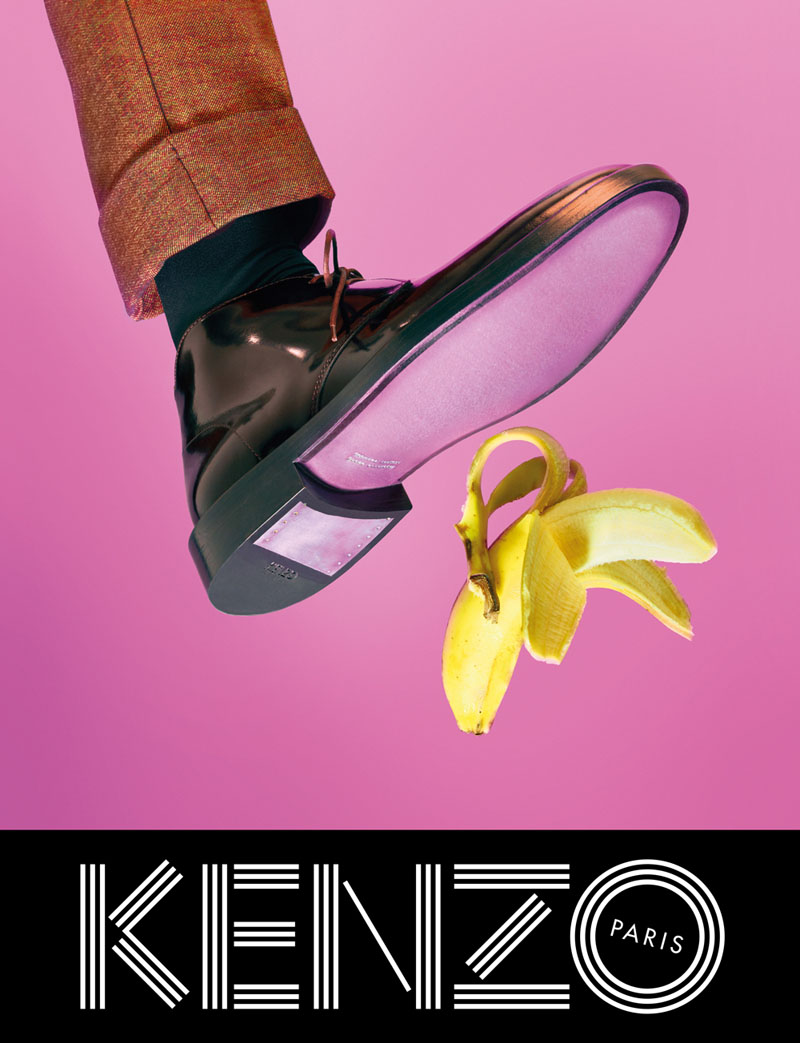
Kenzo collaborated with creative trio Maurizio Cattelan, Micol Talso and Pierpaolo Ferrari behind renowned magazine TOILETPAPER for the fall campaign. As models they hired Sean O'Pry and academy award winning actress Rinko Kikuchi. The result is an amazing colorful campaign that includes surreal situations.
What about flying on a perfect manicured hand? Or a dog dressed up as a tiger? The campaign represents creative freedom in my opinion; you see that nothing was holding the team back for creating 'eye-catching' images. This is my favorite campaign by far this season!

Sabtu, 20 Juli 2013

AFW

SIS by Spijkers & Spijkers
Truus and Riet Spijkers kicked off Amsterdam Fashion Week. The collection is inspired by the fifties with the young Brigitte Bardot as muse. A classic wardrobe with typical BB plaids, stripes, bare shoulders and wide skirts.

Claes Iversen
Claes Iversen showed a collection inspired by Dutch summer rain. The Danish designer played with diffrent layers, lengths and volumes with beaded sequins like a waterfall of raindrops.

Marga Weimans
Marga Weimans presents a more wearable collection this time, with a visible link to architecture and interior design. The designer worked with artist Jeroen Koolhaas, renowned for his work for Prada, on these particular prints.

Dorhout Mees
The inspiration of Dorhout Mees comes from a poetry album from 1800 that the designer recently inherited from her grandmother. Full of love, poetry, drawings and embroideries. All in great contrast with the time from now where we hardly have time for each other and personal contact seems strange.

Anne de Grijff
Anne Grijff makes her Fashion Week debut with a ​​collection inspired by Dutch regional dress. Especially the way in which housewives wore their clothing in the beginning of the 18th century. Women at that time folded their linens and laid it over tightly in the closet. This gave a certain kind of pattern. Therewith they showed the outside world where they came from and that they had a tidy household.

Winde Rienstra
Winde Rienstra found her inspiration in the beauty of abandoned Russian dachas. These are wooden houses, where urban Russians spent the sweltering summers. Poetic works of art, with fine carvings and a large variety of shapes and proportions. In former times, the dachas were abandoned during the long Russian winters, making them temporary ice crystals of remembrance. The purity, wealth and serenity of these abandoned places was the inspiration which Winde Rienstra showed the touching vulnerability of human enclosures

Lichting 2013
The prize is awarded every year since 2007 to the most promising graduate collection in the Netherlands. The greatest talents of the seven Dutch fashion academies give a fashion show together to present themselves to the critical fashion press and industry. This year's jury members are fashion editor of The Independent, Alexander Fury, designer and former Lichting winner, Maarten van der Horst, founder of Not Just A Label, Stefan Siegel and Robb Young, fashion consultant and journalist.


A text of Arthur Schopenhauer, a German philosopher, in which he compares the behavior of porcupines with human society inspired Anna Kathryn Gregor's collection that reflects on human behavior in private and public spaces. Schopenhauer describes the human need for both affection and protection. The natural armor of the porcupine led to deformed body shapes and the usage of elements of safety clothes.

In Anne van den Boogaard's opinion people live safe and colorless lives. Most people don’t take risks or experience highs or lows. The collection is about the element of surprise, pushing the unexpected and being alive in every way possible. It's about exploring boundaries within the aesthetics of ugliness in an anomalous way.

Wenda Harmsen first highlighted the absurdity of footwear with a heel which seems to disappear into the ground and a toe cap which reaches upward instead forward. It is amazing how she combines oversized silhouettes, checked fabrics and rubber coating.

The collection of Anbasja Blanken had the symbolic and spiritual values of mystical light as a starting point. In some cases, light was attributed supernatural, divine and spiritual powers. Hence the term ‘enlightened’ women that refer to those who enlighten the spiritual routes of others through their veils. These women have the power to lead humanity to a higher state of consciousness and represent the highest state of holiness.

The winner of Lichting 2013, HenriĆ«tte Tilanus, made a tribute to eccentric writer Lady Edith Sitwell from the early twenties. The lady showcases her love of art, but also shows a glimpse of loneliness. Loneliness to be a consequence of her misunderstood beautiful creative mind. She translates this into experimental textile operations, like embroidered plastics, hand painted bleached stripes on denim and ripped out threads. 
▲
Top